

Immortal Joseph and Co
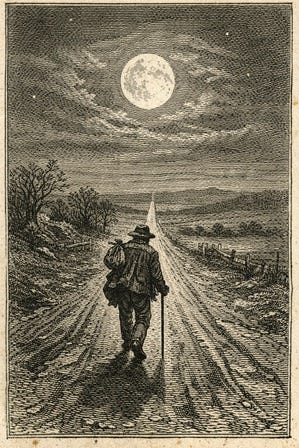
In 1838 an unusual itinerant named Joseph turned up in Rotherhithe (London): ‘He is about thirty years of age, has a Jewish cast of countenance, wears a long black beard, and is extremely cleanly in his person.’ Joseph frequently preached and when he did so he represented ‘himself as the Wandering Jew’. The Wandering Jew, of course, was an immortal, cursed, in European legend, to wander the earth by Christ until the last days.1
Back to Joseph:
His stay in any place is limited to four weeks, as he says he must change his residence thirteen times in each year to propagate the faith. It does not appear that he enacts this part for the purpose of obtaining money as he has frequently refused it, although he very often takes his meals at the houses of many inhabitants in the vicinity, who seem to take great interest in his conversation, which is pious in the extreme.2
There were many such ‘Wandering Jew’ tramps (WJTs) in Europe up until the time of the Great War (and beyond?). Sometimes the WJTs were given this name by local populations and did not consider themselves to be immortals. Agelessness was, so to say, thrust upon them. We are back in London:
Some ten years ago [1850s] there was a dirty, insignificant-looking man with large eyebrows… and very black hair, and for three weeks this poor unconscious fellow who was in the daily habit of walking along Piccadilly was pointed at by everybody as the Wandering Jew.3
The man in question, it transpired, was a house painter!
At other times, as with Joseph, they are self pronounced. Here is one who wandered around the west of England and the Welsh borders in the 1830s:
He never stops but one night in a place, let the weather be ever so hot, wet, or cold, the wanderer cannot rest, but must continue on his journey; and some of the old women declare that they have known him for the last 20 years, and states that he does not look to be one single day older now, than when they first knew him. He tells his dupes that he never can carry but 3s. and 6d. in his pocket at one time, and will not accept of more than that sum as a gift, although he has been frequently offered a sovereign.4
These individuals speak to the way in which settled ‘boring’ populations often project onto itinerants the most extraordinary backstories. These indigents sometimes play along for reasons of survival, profit, belief or lunacy. Of course, forget Kerouac. The ‘romance of the road’ is largely fiction. For every Kwai Chang Caine, ‘walking the earth’, there are a hundred unfortunate souls who through bad luck or mental illness have been forced out of the ‘boring’ populations and into the old changing way.
There but for the grace of God...

Cliff-Jumping Immortal in Scotland
Sometimes encounters with these characters have a numinous charge. A Victorian flower-collector was out in the wilds of Moray when a peculiar invidividual appeared.
‘Good morning, friend,’ said the flower-gatherer, wishing to be sociable.
‘Good morning,’ replied the stranger, abruptly, ‘do you know what you are doing?’
‘Certainly, I am gathering a handful of wild flowers.’
‘Nay, but you are destroying souls,’ was the startling rejoinder.
The WJT explained that ‘the souls of the fallen angels went into plants and flowers...’
The gentleman stood aghast at this strange doctrine, but ere he had time to recover himself the stranger proceeded: ‘Great changes have happened since I was last here?’
‘When was that?’
‘That was at the time of the siege of Lochindorb [about 1340], and at that time I was with Sir Andrew Murray, and conducted his retreat from Lochindorb to Darnaway Castle.’
‘Amazing! how can you say so?’
‘Friend, do not be amazed. I am the Wandering Jew!’
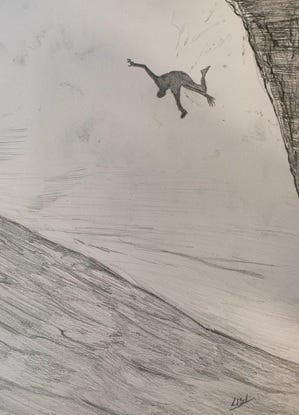
The two were on top of some cliffs: ‘the rock rises straight up from the river to a height of 200 or 300 feet’.
As I pointed to the chasm, I said, ‘Do you mean to say you could leap over that rock and live?’ ‘I’ll soon let you see that,’ said he, and suiting the action to the word, he jumped down, his body tossing from rock to rock until he went splash into the river, and crossed to the other side; and recognizing me, he told me, with a wave of his hand, that he was going over to the Orkneys, but would come some day to see me at my own residence.5
John Alone
I usually am entertained but incredulous when reading these accounts. However, sometimes, just sometimes, I wonder. Consider the following data points.
In the mid 1700s in the north-east of England there was a tramp who called himself the Wandering Jew. He walked through the streets (probably of Newcastle) ‘with a long Train of Boys at his Heels, muttering ‘poor John alone!’ ‘poor John alone!’ in a Manner singularly plaintive’.6
Consider now our second exhibit. In the late 1700s in Bath a man also known as the Wandering Jew traipsed around: ‘in all his migrations, he was never heard to utter any thing but ‘Poor Joe’s alone, poor Joe’s alone!’’7
Then, third, in the early 1800s, another WJ turned up in Scotland: ‘his appearance was… extremely dirty, and [he] had usually a motley train of idlers at his heels, while he uttered, in an idiotic but most pathetic tone, ‘Poor John alone! Poor John alone!’’8
We certainly need an explanation for this pattern, but what? I’m going to rattle out, machine gun style, four possibilities and then try and forget. One, a long-lived homeless man moved from Newcastle to Bath and then up to Scotland. Two, ‘poor x alone’ was a mendicant cry. I’ve not found any evidence of this, but consider Edgar playing ‘poor Tom’ (also in the third person) in King Lear.9 Three, the Scottish WJT is a misremembering of the Newcastle WJT.10 Then, there is the fourth explanation. But, no, no, the fourth explanation doesn’t bear thinking about…
Note that I published a couple of years ago British sources for the Wandering Jew [try other Amazon platforms for those outside the UK] and hope to return to this theme in relation to other immortals.
‘Fanaticism Extraordinary’, Morning Herald (19 Dec 1838), 7.
Ibid.
‘London Correspondent’s Letter’, Monmouthshire Merlin (25 Jun 1864), 8
‘Monmouthshire’, Bell’s New Weekly Messenger (6 Apr 1834), 7
A Citizen of the World, ‘On the Banks of the Findhorn’, Elgin Courant (19 May 1865), 8.
John Brand and Henry Bourne, Observations on popular antiquities: including the whole of Mr. Bourne’s Antiquitates vulgares, with addenda to every chapter of that work: as also, an appendix, containing such articles on the subject, as have been omitted by that author (Newcastle: Johnson 1777), 394
‘Poor Joe’, Staffordshire Advertiser (2 Apr 1803), 3.
‘Fanaticism Extraordinary’.
Act 3, Scene 4.
Notice the hangers-on in both accounts and how typical it would be of a London author to get Newcastle and Scotland mixed up in their memory! If we accept that kind of confusion then the similarity between the Newcastle and the Bath WJ would just be, I suppose, a coincidence?
To shove my oar in, we did an episode on this: The Immortals Among Us: The Wandering Jew and Other Undying Ones
https://www.buzzsprout.com/1859647/episodes/13142425-the-immortals-among-us-the-wandering-jew-and-other-undying-ones.mp3?download=true
Fascinating. Thanks so much for this. I am using elements of folklore mashed up with historic persons in a novel I'm kicking around with and this opens up my mind so much. I don't mean that I will have a WJ in my story--but definitely a wandering wondered about individual features in it.