

Airlifted by the Spirits
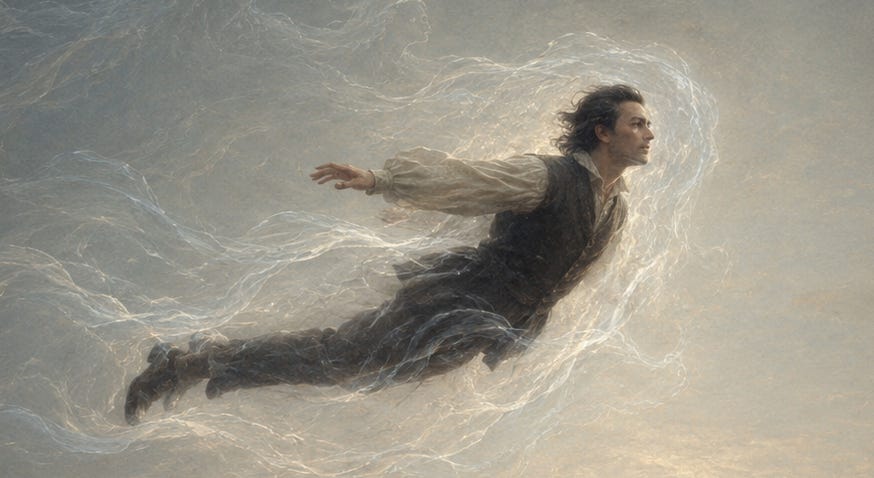
Alex Langstone has recently written on an all but forgotten seventeenth-century pamphlet: Strange and wonderful news from Cornwall. An account of a miraculous accident that lately happen’d near the town of Bodmyn, at a place called Park, 24th May, 1697. The story, put briefly, is as follows. A servant, Jacob Mutton, is lured, late one night, to a bedroom window by the words ‘So hoe, so hoe!’ He is then, as he opens the upstairs window, grabbed, flown across the county, some twenty miles, to Stratton by, well…: ‘a Tall man bore him company all that journey, over Hedges, and Brakes, yet without Weariness or Hurt’. We’ll come back to the identity of the Tall Man below. When Jacob was found the poor chap was still holding onto the bar of the window from which he had been seized. Jacob then walked back to his Master’s house, getting there a couple of days later. I’ve put the entire text in the footnote.1
I call these adventures ‘airlifted by the spirits’. An (i) innocent man or woman is (ii) taken up in the air and flown a long distance, (iii) dropped or dropped off, (iv) then has to make their way home. Often the person is (v) permanently affected by the trip. In some instances (vi) there is some kind of ‘flying proof’ (like the iron bar from the window clutched in Jacob’s hand). In some cases, (vii) the victim is given a choice of the height of the flight. (I’m not going to get into this here, but do you fly through hedges, over hedges, far above…)
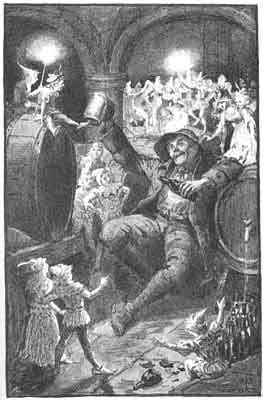
It is worth insisting on flight: being turned into a horse and ridden a long way, say, by a witch is a cousin of this narrative, but it is not the same thing. In fact, this is a sibling of several flying-with-the-spirits narratives from Britain. For instance, there is the tale of the man or woman who are flown off by a spirit and then returned home after performing a service. Other siblings include the pixies flying with a human to the King of France’s wine cellar: the human in those legends usually decides (foolishly) to go along for the ride.2 The motive for the flight in airlifted by the spirits is punishment or just motiveless malevolence.
Airlifted by the Spirits 1500-1700
Alex should be congratulated for being the first to write properly on an early English instance of airlifted by the spirits. But it is not, as I first thought, the earliest. In a 1592 pamphlet we learn that Richard Burt, a farm servant, was bewitched by one Mother Atkins in Middlesex and carried through the air: he held a piece of apple pie in his trembling hand! Richard soared over his master ploughing in the fields and over Harrow church. He came back (after a visit to a hell-like place) with his speech mangled (the pamphlet makes much of his twisted mouth and near-dumbness).3
According to a 1683 pamphlet, one Francis Fey of Spreyton in Devon, on Easter Eve, returning from work, was caught by a female spectre and carried up into the air. Search was made for him, and only half an hour later he was found at some distance from the house, plunged to his middle in a bog, whistling and singing. Francis solemnly protested that the spectre carried him so high that he saw his master’s house underneath him no bigger than a hay-cock!4
Interesting how all three cases involve male servants.
This is not the place to discourse on the unreliability of sixteenth- and seventeenth-century pamphlets. But it would be fun to chase down some of these individuals in the parish records (if they are there). I’ve failed to find Jacob Mutton, for instance, in his part of Cornwall: Alex has pointed, instead, to some verifiable points in the account.

Airlifted by the Spirits 1700-1900
But this was not just print folklore, with similar stories being palmed off on different locations. There are also quite definite accounts from lived folklore. Edmund Jones in Monmouthshire, Wales reports that a brother of his, in 1733, went out drinking. At a certain point of the night he left the tavern to empty his bladder. But he did not come back…
The company were still waiting and expecting his return, and slept little. Next morning, not very early, he came to them. They were exceeding glad to see him, though he appeared like one who had been drawn through thorns and briars, with his hair disordered and looking bad, who was naturally a stout man, and of a good healthy complexion. They were very curious to know where he had been, and what had happened to him. He told them he had been travelling all night in unknown, rough ways, and did not know where he was, until early that day he saw himself at Twyn Gwnlliw, near the entrance into Newport Town, where he helped a man, from Risga, to raise a load of coal which had fallen from his horse. Suddenly after he became insensible, and was brought back into the place from whence he had been taken. In a few hours, therefore, he must have been carried by these infernal spirits, through the air, more than twenty miles, for so long the way is from Newport to Langattock village.5
Perhaps this should not be counted because the brother was returned to where he had begun?
Here instead is an early nineteenth-century example from Bedfordshire and the Ouse Valley from an interesting author who I’ve called elsewhere ‘Preternatural’.
…an old man named James Carter used to relate with a perfect confidence in its truth that, when he was young man, he went one Sunday morning into the woods along with a companion to gather sticks, and whilst he was occupied in this employment the devil suddenly snatched him up into the air, flew away with him, and set him down in a distant part of the wood.6
Then there are many Scottish instances of fairies carrying men on aerial ‘joy’ rides: joy for the fairies not for the poor human. This is a cracker from Walter Scott and unusual because it is Lowland; most such stories are from the Highlands.
The victim of elfin sport was a poor man, who, being employed in pulling heather upon Peatlaw, a hill not far from Carterhaugh, had tired of his labour, and laid him down to sleep upon a Fairy ring. When he awakened, he was amazed to find himself in the midst of a populous city, to which, as well as to the means of his transportation, he was an utter stranger. His coat was left upon the Peatlaw; and his bonnet, which had fallen off in the course of his aërial journey, was after-wards found hanging upon the steeple of the church of Lanark. The distress of the poor man was, in some degree, relieved, by meeting a carrier, whom he had formerly known, and, who conducted him back to Selkirk, by a slower conveyance than had whirled him to Glasgow.7
Who was the Tall Man?
This brings us back to Jacob in 1697. Jacob claims that he went to the window hearing the words ‘So hoe, so hoe!’ When he got there he was taken by a ‘Tall man… over Hedges, and Brakes’. Who was this individual? As we’ve seen above the force behind supernatural flight could be fairies, the devil, spectres or witches. Alex connects the flight with pixy legend of nocturnal visits to various wine cellars. I am sceptical because in those legends the taken human usually makes a conscious choice to tag along or, if swept along, seems to enjoy him or herself. Jacob is grabbed and miserable.
The clue to the Tall Man mystery is, IMHO, in ‘So hoe, so hoe…’ ‘So hoe’ was a hunting phrase, analogous to ‘tally ho!’, i.e. we’ve spotted the hare etc.8 That might mean one of two things. First, that Jacob was being called along on the hunt; or more worryingly that he was the hunt. We do have, in the nineteenth century, in Britain, a series of ‘hunter’ figures who race along in the sky or, more often, the ground searching out sinners. This is true also of the south west, particularly Dartmoor. My guess is that Jacob was spied by the supernatural hunt and that he was, however briefly, the hare…
That leads to another point about Airlifted by the Spirits. ‘So hoe’ is a hare hunting call. Is it a coincidence that in the Middlesex and Monmouthshire account the supernatural flight is preceded by a narrative about witches turning into hares and being hunted? In both cases the event is tangentially linked with the flight that follows. Sometimes we see the wiring of older legends sticking out through in narratives. Is this one such case?

The Truth of the Account here given of what lately occurr’d in Cornwall, is con-firm’d by Letters from Gentlemen, of great Worth and Integrity, of the Neighbourhood where this Remarkable Accident happen’d; to which I might add, were it needful, the strict examinations and Enquiries that were made by the aforesaid Gentlemen, before they would Write anything touching this matter, together with many other Passages that sufficiently demonstrate the Reality of the Thing: but the general Belief it hath obtain’d in the West, saving me that Labour, I proceed to the relation those letters give. On Sunday the eighth of May, one Jacob Mutton, whose Relations are of good Repute, being a Servant to William Hicks, Rector of Cardinham, at a Tenement he hath in Eglos-hale. called Park. as his Hynde, near the Town of Bodmyn in Cornwall, going up into his Chamber about Eight a Clock that Terrible Evening, with the Lad that was his usual Bedfellow, the Man was undressing, and the Lad in Bed. when a hollow Voice uttering So hoe, So hoe, So hoe, occasion’d his going to the Window in the next Room. which was seventeen foot from the Ground. whence the Voice seem’d to come; and had no sooner lay’d his hands upon an Iron-Bar thereof, then all gave way, the Cross-Bars were found on the Ground under the Win-dow, but the Bar was the next Morning found in the Man’s hand, who lay Sleeping in a narrow Lane, four miles beyond Strat-ton, in the said County (where he never was before in his Life) and which place is about Thirty miles distant from the aforesaid Tenement, called Park. The Persons that found him, were the Earliest Goers to Stratton-Fair, then held: where having no acquaintance, after he was wak’d out of Sleep by the said Passengers, amazingly Asking them where he was, was by them Conducted to Stratton-Fair, and thence directed home that Munday-night in the said county, about twenty miles from the place where he was found; and on Tuesday Morning return’d to his Master’s estate without any hurt at all, only very Melan-choly, saying that a Tall man bore him com-pany all that journey, over Hedges, and Brakes, yet without Weariness or Hurt. But what became of his Fellow Traveller he can give no account, nor when he left him. or if he had the Iron Bar or his com-panion, whilst they were on their journey he does not at all remember, nor how it came into his hand. To conclude, this Young Man who is the Occasion of this Strange and Wonderful relation was never before this accident accounted in any way inclin-able to Melancholy, but on the contrary esteemed Merry, Airy, Brisk, and Honest young Fellow. London. Printed by J. Wallis, within White-Fryars-Gate, next Fleet Street, near the Joyners Shop.’ I don’t have access to the original and have taken this from ‘In 1697’, Cornish Guardian (30 Jan 1930), 6. I prefer this version because, unlike previous copies in the press, the English seems not to have been modernised.
In British folklore circles a lot of this has been classified under ML 5006* Flight with the Fairies. This was coined by Briggs in the early 1970s. See also Following the Witch ML 3045. Note that the best breakdown of flying with the spirits from Britain is Donald Archie MacDonald, ‘Migratory Legends of the Supernatural in Scotland: A General Survey’, Béaloideas 62/63 (1994/1995), 29–78 at 70: ‘F34. Man Taken by Sluagh and Made to Wound someone (Woman, Animal) with Elf Shot[;] F35. Fairy Host Deposits Minister who Won’t Believe in them on own Doorstep[;] F36. Fairy Host Takes Man from Bed and Brings him Home. Describes what he Saw. Sometimes Hurt by Fall on Way[;] F37. Other Tales of Person Shifted by Fairy Host[;] F38. Carried where he wants to Go.’ Highly recommended: Willem de Blécourt, 'The Flying Charm: To Cologne in the Wine Cellar. On the History of a Scholarly Legend', Incantatio 8 (2019), 9–28.
A most vvicked worke of a wretched witch (the like whereof none can record these manie yeeres in England.) Wrought on the person of one Richard Burt, seruant to maister Edling of Woodhall in the parrish of Pinner in the Countie of Myddlesex, a myle beyond Harrow. Latelie committed in March last, An. 1592 and newly recognised according to the truth. by G.B. maister of Arts.
Summarised in Sabine Baring-Gould, Devonshire Characters and Strange Events (John Lane, 1908), 170-174.
A geographical, historical, and religious account of the parish of Aberystruth: in the county of Monmouth (1779), 81-82.
‘The Preternatural’, Bedfordshire Times (8 Mar 1873), 7.
Walter Scott, Minstrelsy of the Scottish Border, vol. II (Kelso: James Ballantyne, 1802), 226-7.
Galfridus Grammaticus, Promptorium Parvulorum sive Clericorum: Lexicon Anglo-Latinum Princeps, ed. Albert Way, vol. 1 (London: Camden Society, 1843), 251.
One thing I noticed only as I was publishing. This is the year after the Ann Jefferies pamphlet.
Can't help but point out that flying in dreams is a common feature we all experience sometimes, although when I've had such a dream, I usually can't get very far off the ground. Loved this one, Simon. 🦋